Category Archives: Productivity Experiment

Productivity Experiment Week 2 Baseline Results

Yeeeeeah.

Welp.

It was a week. That is a thing I can say about it.

I mean, it wasn’t all a bad week. It was a pretty reasonable baseline measurement week, actually. Between Monday and Friday I only managed to work 12 hours (mostly writing hours), but I added 12,829 words to my manuscript.

Not as many as I want to be adding per week. Not as many as some people add per day. But that’s not the point. Progress is progress, and I did my best every day.

I averaged about 3 hours’ work on days I was working… which did not include Thursday. Thursday was one of those days I mentioned needing to be prepared for. A migraine and back pain teamed up to leave me in a painkiller-and-brain-fog stupor, which in turn left me lying on the couch watching Roseanne all day.

I got the box set for Christmas. It is most excellent.

I watched more TV on that one day than I usually do in a week. I don’t feel bad about that. It’s not like I could work. So Thursday was a write-off.

And that’s kind of how things go. Sometimes my best is the 4780 words I wrote on Tuesday. Sometimes it’s trying not to feel guilty about taking a sick day.

So between that and my struggles with trying to get started on work in the morning (or like… any time), trying to fit yoga with my husband into our schedule, and having a regular school week to deal with, things were pretty normal around here. Score one for the baseline measurement!

And I got other stuff done. People got fed. No one was crushed under a pile of clutter or choked to death on litter box fumes. A kid had a friend over. I worked on a sample edit with a potential new editor and made last-minute plans to do a panel at Atlanti-Con. I helped with homework. I watched a movie. I waked my dog, and I found time to read. Stuff. Lots of stuff.

Judging by my notes from the past two weeks and my memory of how things worked last year, I’m calling this the baseline against which I’ll be measuring future results:

  • Work hours: 15
  • Words per writing hour average: 1200
  • Sleep: 8-8.5 hours per night
  • Energy: generally low, crash by 6:00 on weeknights

So what does wrapping the baseline weeks up mean?

It means that this week, I start the Godawful Early Schedule.

I’m more excited about it than that name implies. Yes, it’s going to be crazy hard to get up an hour earlier than I do now to fit in 90 minutes of work before I wake the kids up. I’m used to getting up early-ish, but I’m not exactly energetic or what you’d call mentally present in the morning. I may cry. I might not word good.

But if I can make it work?

If I can make it work, I could get a good chunk of my work for the day done before anyone has any reason to interrupt me. I could be alone with my work when I’ve just rolled out of dreams, before distractions have a chance to get to me. I could let ideas filter in the back of my mind while I get the kids up and out, and maybe have new ideas when I get back to writing. Or I could continue drafting in the morning and do edits later, using that natural schedule break to split my day and still finishing my work day by 12:30.

I could have afternoons free for napping so I won’t crash so hard at supper time, or to get a walk in to help me shift gears before home and family time. Maybe I’ll be able to enjoy my evenings instead of watching the clock to see if it’s bedtime yet.

That’d be cool.

We’ll see how it goes. My big plans might not pan out, but there’s always a chance.

(This Thursday’s post is going to take a look at the productivity tips and tricks that are already working for me, which will conclude this series of experiment intro posts. After that, I’ll post reviews of some productivity books, talk a bit about writing/being my own boss and productivity, and of course posting updates on the experiment. Let me know if you have questions/topics you’d like to see covered!

…Assuming I don’t fall down the stairs in a sleep-deprived stupor some early morning and find myself unable to post. It’s not unpossible.*)


*Unpossible is a perfectly cromulent word.


The Productivity Road Test

21533872_10155443612035325_1687003029_o

So, what’s this great experiment going to look like, anyway?

My brain had more than a few ideas.

(Fun fact: I have a lot of trouble focusing on writing and business tasks, especially when I’m trying to get the ball rolling every day. But show me a bright, shiny idea for a new interest or project and it’s like a switch has flipped in my brain that turns me into a mega-focused idea generation machine. If only I could use my powers for good instead of procrastination…)

I wrote down a lot of those ideas, discarded a few, and wrangled a bunch of them into what I’m calling phase one of the experiment. The whole thing is ridiculously unscientific, of course. The fact that I’m tracking my time and focusing on productivity will no doubt offer a false boost to my focus and productivity. My sample size is moi. I can’t control other variables that might affect outcomes when I’m testing an idea because this is life, and life is messy.

But I can plan, I can implement, I can track, and dammit, I can take notes.

And I can make some rules to keep my rebellious mind in line (maybe):

  • Give ideas a fair shot, including time to adapt to changes and to account for health/hormone fluctuations. Unless something presents a clear danger to my health or well-being (or anyone else’s), stick it out.

  • I will not try illegal drugs, questionable supplements, crazy diets, etc.

  • Work productivity will ideally not interfere with home and family responsibilities or my ability to take time to (attempt to) relax. Short-term scheduling experiments may impact the hours I spend available to my family, but should not get in the way of commitments I’ve decided are a priority (like helping with homework/projects, taking time to walk the dog, cooking supper, packing lunches, spending time hanging out with my husband, listening to the kids talk about their interests*, etc.)

  • Control other variables when possible. I will do my best to take medications consistently, get the same amount of exercise each week, sleep the same number of hours, and not make any huge changes to my diet unless I’m actually testing those changes.

  • Be honest about the process, results, successes, failures, and obstacles that affect outcomes (even if they make me sound like a whiny baby or look like an ass… and I totally will).

  • Post results on the blog once per week. Add other posts when possible on related topics. Write posts on the weekend so procrastiblogging is not an option, and don’t count writing them as productive work time. They’re not, even if they feel like it. This is a hobby that will hopefully support my work. Got it, brain?

  • When possible, cite the sources of ideas and information used in the experiment.

So, how are we going to do this thing?

*cracks knuckles*

It’s going to be pretty low-tech for the most part. One of the “hacks” (ugh, I hate that everything is a hack now) that works for me is limiting the time I spend with my phone in my hand, as it inevitably leads to temptation and distraction from email or social media. I don’t use electronic calendars, time-tracking apps, or to do lists if I can avoid them.

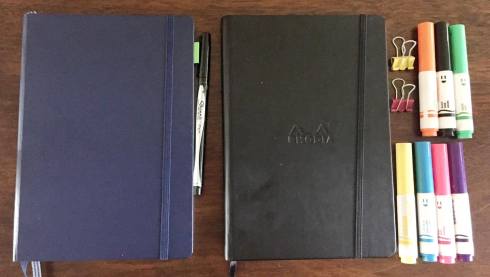
I have a notebook, pens, and markers.

I have a Fitbit.

I have an app to block internet sites while I’m working, though I have honestly never used it and should therefore probably test it separately. So scratch that one.

I have Phone Jail, which is a box where my phone lives when I’m not actively using it or out of the house (and which keeps me from losing my phone, which I do a lot.)

I have my bullet journal, which is also a notebook. But it’s a different notebook, so it’s on the list.

And I’ve got books that are full of ideas.

Here’s how I’m putting them together.

  • I will be tracking how I actually use my time. As I write this, I’m on day one and am already hitting snags (my tendency to float from task to task if I’m not working at the computer means accuracy is difficult even if I track my time in 15-minute increments. And the fact that my Fitbit only lets me set 8 alarms a day means I have to rely on my phone–the one that’s supposed to be in jail–for the rest. Seriously, Fitbit. The heck.) This is where the markers come in. Tasks/activities are colour coded and broken down into categories like work, exercise, personal time, family/home focus, and sleep. I have no doubt I’ll need to mess around with these categories (and find a way to track focus vs. multitasking and minutes spent procrastinating) but it’s a starting point.**
  • I will also be tracking my energy levels every hour to see how changes might affect them.
  • I’ll be noting water, caffeine, food, and exercise in case I need to look back on them later.
  • I have a list of ideas to try out. I also have a list of “nope” ideas I’ve come across, because you just never know when a nope might become a “but what if…”
  • I’ll be noting my hours worked, word or page count (drafting vs editing) and business hours/accomplishments, mood, energy and focus I have left for post-work stuff, and other measures that will help me more judge what’s happening.

All of this is just to help me track the results of my experiments/changes, and it’s really important. I’m a terrible judge of both how I use my time and how long tasks take. My memory of how I’ve used my time is also awful, so I tend to feel unproductive at the end of the day even if I’ve crossed off a whole lot on my list. Stopping to think about it and make accurate notes every hour will force me to look at what I’m really accomplishing instead of what I feel like I’m accomplishing.

Not everything is objectively measurable. If I write 10K words in a day but end up burned out, headachey, and miserable (with my kids starving and the litter box overflowing), I can’t call that a win. That’s why I’m tracking the non-objective stuff, too.

The Plan

Weeks one and two will just be me working the same hours I attempted to work last school year, but with attention to how I’m really spending my time. How long does it take me to actually sit down and work after the clock starts running? What’s getting in the way? What hours are the most productive, assuming I’m focused? I’m not changing anything (except that increased awareness of how I’m spending my time), but seeing what I can do without making any major changes. This schedule frequently felt like it was working for me, so for now it will be the baseline I’ll test other options against to see whether they’re helping or hurting me.

Then I’m going to move on to the one major factor that will actually affect the number of hours I have available for work and personal (ie not home/family) time: My schedule. We’ll get into details on the hows and whys later, but the basic plan is to experiment for four weeks with what I’m calling the Godawful Early Schedule (waking up at 5:30 to get 90 minutes of work in before I need to get the kids up and out, working through the morning after they’re at school, and using afternoons for reading, exercise, and restoration so maybe I’ll actually be awake after supper). The second schedule I’d like to test is the split shift: Working during the day and then attempting to add a few scheduled hours here and there in the evening after everything else is taken care of or on weekends.

(Yes, this is where the blog comes in. It’ll be easier for me to stick to early mornings/justify later hours to myself and my family if it’s For Science But Not Really Science rather than just me kinda trying a thing.)

And then? Then I’ve got an ever-growing list of ideas to try once I’ve settled on a schedule that works for me. Some of them are weird. Some of them make me want to slap myself for even considering them. Some will require big commitments and further changes to my routine. Most are smaller. All will be challenging, but I hope some will be rewarding.

Let’s go.

(In the next few posts we’ll talk about what my current schedule and productivity look like, what I’m working on, and the productivity techniques that have worked for me. Yay, groundwork… ^_^)


*Minecraft. They talk about Minecraft. And other people playing Minecraft. Save me.

**I’m reviewing and posting this on day four, and this has already evolved a lot. We can look at that in another post once I’ve got all the kinks worked out.


The Problem with Productivity

Remember when I said I’d like to see information on productivity for those of us whose lives don’t look like the typical career-oriented person? Well…

21362377_10155436501855325_160830386_o

I’ll admit it. Planning and productivity are kind of a hobby for me. I have a planning system that works for me, but I still have a hard time resisting the allure of a new paper planner that promises to guide me in using my time better. And reading about productivity, brain science, and psychology are as entertaining for me as a good novel. It’s fascinating, and it leaves me feeling like the world is full of nothing but potential for reaching my loftiest goals.

I’m very aware that planning does not necessarily equal follow-through. There’s a danger of spending a whole lot of time researching/planning and none actually doing the parts that require work and sacrifice. But all told, this little hobby has done great things for me.

But as I noted in my last post, I have trouble connecting with a lot of advice.

In my reading, I’ve noticed that the subjects held up as examples don’t tend to have lives that look like mine. They’re men (mostly) whose lives revolve around a cycle of work and restoration. Even when it’s acknowledged that they have kids, there’s little indication that it affects their schedules or flexibility in a major way. I often see few women, and fewer who are balancing work with primary responsibility for a home and family*. Fewer still who are also dealing with mental or physical health challenges that can stop productivity in its tracks or whose lives otherwise include factors outside of the standard work/life balance.

And that’s actually fine. We all like to read about the massive successes, the people who organize and use every hour for peak effectiveness. The people who win wars, make half a million dollars a quarter, write multiple bestsellers every year. Of course we do. It’s fascinating. Inspiring, even, and that’s a valid reason to study them. I’m absolutely not complaining that no one follows someone exactly like me around with a stopwatch and a fMRI machine to study her brain waves, and I know stories like “Gina needed two hours to settle down to work and then wrote 1000 words before the school called to say little Jimmy was puking in the coat closet” ain’t gonna make for a productivity bestseller.

But what does it look like when people with different obstacles (or just making different choices) try to follow their example? Our stories don’t show up on those pages, but they’re ones I’m interested in reading.

I have factors in my life that affect my potential productivity. I don’t consider them all negatives by any means. Quite frankly, my life rocks my socks most of the time, even if I get frustrated by the amount of work I’d like to do but can’t/don’t. Some of them are generally negative, but even then I can often see a bright side.

Things like working only during school hours because me being available when the kids are home makes things run more smoothly around here (and because I find it less stressful to not have the office door closed when everyone is home). Being the primary caregiver for kids and the person ultimately responsible for most aspects of running a household (which I know I’m privileged to be able to do, but I find all of it mentally exhausting). Migraines that can limit my productivity to some degree for two weeks out of every month. Limited physical and mental energy. Issues relating to the ADD** I’ve dealt with my whole life but was only recently diagnosed with.

There are other factors that affect my productivity, but you get the idea. I don’t look at these as excuses for not getting things done, but variables to play with as I work toward doing what I want with my life. I also have a lot of advantages. I’ve been a SAHM since our second child was born (full disclosure: this was because I’m not qualified to do any job that would cover the cost of daycare), and this offered me a bit of flexibility when I started my work as an author. I’m naturally inquisitive and can learn quickly if something really catches my interest. I’ve only got a high school education (plus one year of university), but it was a good one. I’ve got a fantastic doctor helping me out. My family supports me. I’m my own boss, which is both a positive (unlimited sick days!) and a negative (nobody cares if I don’t get my work done!). Everyone’s life is a unique mix of challenge and opportunity.

And this can make it hard to get on board with a lot of the suggestions in productivity books. Reading them can actually be a little disheartening. I don’t have the resources I’d need to hire a nanny*** even if I wanted to. I can’t take off for a sabbatical/reading week/focused writing retreat just because It’s Good For My Career. Napping in the middle of the day probably isn’t going to happen, and my other responsibilities aren’t going to get out of the way so I can work during my biological prime time (which starts about 30 minutes before school ends). I have a lot of trouble switching gears, especially once I get really focused on a task, so playing Tetris with my schedule and fitting work in 20 minute bursts around other responsibilities hasn’t worked for me so far.

But like I said, I’ve learned a lot from my interest in productivity. The key isn’t trying to follow exactly in anyone else’s footsteps, but taking a few steps back and asking how an idea might be changed, adapted, turned on its head, mangled, or shifted to look like something I can use.

My time is limited. My focus is often crap (and when I do get into a really focused state, my schedule often limits how long I can stay there). But in 2010 I started writing. In 2014 I published my first book. Since then I’ve published five more (ranging from 53,000 to 192,000 words) and am happy to say that writing is, for now, my job. That’s not a lot of books by many people’s standards, but for me it’s a dream come true. I run a business, and even if I don’t do a great job of it and generally feel like I’m falling behind and always seem to be playing catch-up, I’m making it work.

I’ve managed it by making other people’s ideas work for me, and I know there’s more I can do with that.

So I’m not going to sit here and moan about why I can’t use everything I’ve learned.

Pfft.

No. What I’m going to do is an experiment.

While I was reading Rest (see previous post), I decided that I was going to try some of the ideas presented there and in other books, but I was going to try to fit them into my life instead of demanding that my life get out of my way.

And that to keep me accountable for sticking to the changes I was experimenting with and for tracking the results, I was going to post about it here.

For the next two weeks I’ll be working my regular schedule from last year (and trying to get back into routine after an August that didn’t include many solid work days), and I’ll post about the rules I’ll be playing by during the experiment. Then we’ll get to the good stuff: trying a major schedule change or two, then playing with other ideas to see what clicks.

For now, here’s my goal:

To experiment with productivity hacks and lifestyle changes in order to find a DAILY and WEEKLY ROUTINE that allows me to reach my personal best focus and productivity without leaving me burned out or forcing me to neglect my health, home, family, or the time I need to rest and pursue other interests.

Obviously it’s not a perfect or typical productivity experiment. My goal isn’t to maximize work productivity and squeeze every drop of get-er-done out of every hour of the day. It’s not to find a way to work 50 or 90-hour weeks with kids at home, and it’s not to find a way to publish six books this year and hit a bestseller list while I’m at it (though those are all awesome goals if they make your personal motor run). It’s to figure out how to manage my attention and energy during my limited work hours to make the most of them, to stop wasting time, and to stop feeling guilty about the things I’m not doing during those hours.

…and to stop feeling guilty about not working more. There’s a lot of guilt. That needs to go, too.

My goals, my methods, and my results aren’t going to be a roadmap for anyone else to become more productive. Even if you also happen to be a writer with kids, we’ve all got different challenges, advantages, and ideas of what a good life looks like. My stumbling blocks might even look like someone else’s dream life, and I’ll seem like a jerk for not appreciating them. But I hope my posts will present an example of adapting ideas about productivity to fit a life that doesn’t necessarily look like the ones in the books I get those ideas from. Along the way I’ll share my thoughts and ideas I’ve picked up from the books I’m reading, topics related to my productivity quest, and insights I run into. And my results will be focused on real work, not on hours spent on this project. You’ll see my hours, my word counts, my plans, my successes, and my slip-ups.

If that sounds like something you’d like to follow along with, stick around. It might be interesting, and I hope it’s going to be a lot of fun.

(And if you have any ideas you’d like to suggest/questions about what I’m doing, or want to point me toward a resource you’ve found helpful, feel free to comment any time!)


*That’s not to say there aren’t books out there with a different perspective. I’m reading (and will review) I Know How She Does It by Laura Vanderkam, which looks at women with careers and kids. The focus is still on people who make $100,000+ per year and have things like daycare and nannies and business trips, but there are people out there looking at how parents are making things work for them, and that’s pretty cool.

**Yes, I know. It’s ADHD. I have a non-hyperactive subtype that’s common (and commonly undiagnosed) in women, and much of the reading I do about it refers to it simply as ADD. Doing so feels easier for me than clarifying the particulars of what I deal with, so that’s what I’m going with here.

***One of the books I’ve read on managing ADD (written for women) suggested hiring a babysitter so you could focus on getting the dishes done. Sounds swell, but again, not so practical for most of us.



Anastasia Writes

politics, engineering, parenting, relevant things over coffee.

Beth Camp

Writer of historical fiction and teller of tales . . .

rogerbloomsfield

An Aspiring Author's Adventure

TBN Media

Life, writing, books, dragons- not necessarily in that order. Home of USA Today bestselling Fantasy author Kate Sparkes.

Allie Potts

Author, Writer, & Inventor of Worlds

The Wordy Rose

"Either write something worth reading, or do something worth writing." - Benjamin Franklin

Shan Jeniah's Lovely Chaos

Finding Yessings and Blessings in Lifes Messings!

Little Rittwolf's Book Blog

I thought having my own blog would help me....Squirrel!....stay more focused. I could be wrong.

The Sword of Air

Stunning new multitouch iBook by breakthrough author R.J Madigan

CHOUETT

Read it! 📖 Spark it! ✨

Denise D. Young

Wild Magic. Wild Stories. Wild Souls.

chestnut book blog

Read. Recommend. Revel.

inkedrainbowreads.wordpress.com/

LGBT Book Reviews, Cover Reveals & More! We are a group designed to help promote and review LGBT et al books. We were created out of seeing a need and wanted to have that need filled. We pride ourseles of having opinionated reviews that are unique and helpful to the author. Welcome to a world of the best LGBT et al books out there!

Dionne Lister | USA Today Bestselling Author

I love sharing my stories, but I wish they wouldn't keep me awake at night.

Avid Reviews

Fantasy and Sci-Fi Reviews For Both Self-Published and Traditionally Published Books

Author Jen Wylie's Blog

Welcome to my mind... Blog for fantasty author Jen Wylie