Category Archives: books

Book Review: The Night Circus

I loved it. I almost didn’t finish it. I’m so confused.

http://www.goodreads.com/review/show/505089719

Bottom line: I had issues, but would recommend giving it a shot* 🙂

*(As A.M.B. noted, I might not recommend shelling out a lot of money for it, but read a sample, borrow it from a friend, get it from the library… try before you buy, maybe? You might love it)


Manic Monday

First of all, thank you to all of you who commented, liked, or otherwise showed support last night when I mentioned my kid’s cough. It means a lot to me.

As many of you might have predicted, his cough was better this morning, because why would it stick around when the doctor needed to hear it? But we went to the ER anyway, a very nice doctor saw us, and the poor kid might have a lingering case of strep (even though he has no fever and is at this moment running around the yard yelling, “BUT SHE’S MY WIFE!”). So antibiotics it is to try to get rid of the itty-bitty pustules in his throat, and holy CRAP that’s a disgusting word. That’s going on the list, which you can still feel free to add to. Ugh.

What was I saying? Oh, right. So that took up most of the day, because the hospital is 45 minutes away, ER’s are busy, and then there was McDonald’s and the library. I was going to post something a bit more substantial today about why I don’t feel qualified to post writing advice, only personal experience and example, but my brain is too fried to do it. Basically, I’m an unqualified bum, and maybe I’ll expand on that another day. 🙂

Oh, speaking of the library, which should I read first?

20130429-163601.jpg


I’ve Got a Dream

Some of you will disagree with everything I say here, and that’s okay. I hope this doesn’t get too depressing for anyone. It’s not meant to be. This is what happens when reality gently taps me on the shoulder and reminds me of what’s important. (I’ve re-written this post four times already, I’m done.)

Let’s start with this, because it’s amazing:

Damn, I love me some Flynn Rider.

Those guys have dreams. Perhaps not realistic dreams, but they’ve got ’em. Don’t we all? I know I do, and I know (because I’m a little psychic because I read your wonderful blogs) that many of you share my dream. Not for me– for yourselves.

We want to write. We want other people to read and love what we write, and we’d really like to get recognition and at least a wee bit of money for that. We want to see our books on a shelf and go, “Yes, that’s mine. I did that.” And then if you’re me, dissolve into a puddle of tears because this is what you’ve always wanted.

Doesn’t sound like so much to ask, does it? Some of you are laughing right now because you know that it IS a lot to ask, and it’s a hard dream to have. And it’s a dream that an unbelievable number of people share, all of them caring as much about their work and believing in it as hard as I do mine. I find this very humbling.

It’s a great dream, don’t get me wrong. When you love what you’re doing and there are examples in front of you every day of people just like you making it, getting their books published and turning into massive bestsellers, you think, why not me? When you get to the part where you’re collecting rejections, there are stories of those very same authors and books getting  just as many rejections. You think, “it’s part of the process.” Well, I assume you do. I don’t have much experience with this part yet, but I will, one way or another. We all do, if we put our stuff out there.

We maintain hope, but  at the same time, we understand that for most of us, it’s not going to happen. Whether because we’re deluding ourselves when we think our work is good enough (not you guys, your work is the cat’s pajamas. I’m saying me and those shady-looking writers over there), or because of a variety of factors beyond our control*, we’ll be lucky to see our beloved words in print.

Oh, we can skew the odds in our favor, for sure. We can read up on writing craft (and read everything else we can get our grubby mitts on and learn from), we can make our work the best it can be, we can market the heck out of it, we can go to conventions** and meet agents or editors who just might remember us if we make a super-good impression, we can spend hours and days crafting the perfect query letter. We can hire great editors and take their advice, we can find amazing cover artists and devise the perfect pricing strategy. It makes a difference. It doesn’t guarantee success.

Depressed yet? I’m not.

There’s a kind of freedom, for me at least, in knowing that the odds are long and the road hard, in understanding that some things are beyond my control, and that that’s absolutely, perfectly fine. It helps me understand the difference between goals and dreams. Writing the best books you can and doing the best you can for them, that’s a worthwhile goal. Having a bestseller that’s made into a blockbuster movie and then there’s the money and let’s say a super hot actor falls in love with the author behind it all (hey, why not, right?) is a dream. If it keeps you going, it’s a good dream. It’s not a reasonable goal, though, and we’re all going to be mighty disappointed if we make that kind of luck and success a goal we expect to achieve.

Optimism is necessary, and it’s fantastic. Realism is, too, but in a different way. I say we need both.

This brings me to another, tangentially related topic. You know those people who seem to pop up on every agent’s blog asking what the next big thing is going to be, as though they can write it to order and be guaranteed an agent/contract/publication/bestseller? That’s hilarious, isn’t it? Kind of adorable.

There’s a reason they say to write what you love, and to write because you love it, not because you think you could be the next Stephanie Meyer if only you could catch the wave of the next trend in publishing. Odds are you’ll put a lot of work into something you don’t actually care about, and have little to show for it. No matter what you do, books that aren’t as good as yours will probably rise higher. It sucks, but it happens (not mentioning any names). But if you love what you do, believe in your stories and feel passionately that this is what you’re meant to be doing, you’re not wasting your time. Whatever level of commercial or critical success you achieve (or don’t), you’ve done something worthwhile.

I like that idea.

So yes, I’ll polish up this book that I’m working on, wash its face and send it out into the world, telling it to play nice with the other kids (but not too nice) and not to trade its carrot sticks for cookies in the lunch room. And then I’ll get back to work on the next one, because that’s what I do.

Publishing may sometimes seem like an exercise in futility (and I’ve deleted paragraphs outlining why this is so, you’re very welcome), but writing never is. Not if it’s what you love.

*(that agent just signed someone and doesn’t care to add another just now; your book isn’t on-trend and the publisher doesn’t want to take a chance; you decide to self-publish and through the whims of fate and Amazon your book never gets any exposure)

**If you can do this, I’ll try to only hate you a little for it.


Since We’re Talking About Character Descriptions…

People seem to agree (at least, in the comments on my last post) that less is more in character description, and natural better than forced.

So of course, I had to write the worst character intro description I could, because doing things the wrong way is way more fun than it should be.

Come on, you’d totally keep reading this, right? 😉

(for Jae)

I interrupted the flow of early-story action to study the oil painting of myself I’d just happened to finish the night before, because looking in a mirror is, like, so cliche, amirite? My sapphire blue eyes captivated me from beneath perfectly groomed, raven black eyebrows; my lips were like ruby-red cushions of desire, and my adorable little nose was almost as perky as my breasts. My alabaster skin glowed in the painting as it does in real life, like, all the time, and I sighed excessively over the tiny mole on my upper lip that everyone said lent my appearance a charming hint of imperfection that is so important in a heroine, but that I hated with a passion. Because I’m flawed. Did you catch that?

“Dude,” said my boyfriend, who was ridiculously handsome in ways that I will explain in excessive detail in a few paragraphs, “you are beautiful, and you forgot to mention that your earlobes are small but perfectly formed, but perhaps you could admire your painting and think more about your appearance when there aren’t any zombie capybaras invading your family’s colonial brick mansion, which is lovely but really not defensible in any way?’

I sighed and flipped my long, wavy, ebony locks back over a perfectly formed shoulder. ‘Fine,’ I said, ‘but when we get to the obligatory Zombies in the Mall Scene, I insist on at least twenty minutes in a changeroom with adequate lighting and a 3-way mirror. The People have a right to know how my butt looks in a miniskirt.”

He didn’t answer. A capybara was gnawing on his kneecap. Asshole.


He Looks Like What?!

So here I am, reading “Imminent Danger and How to Fly Straight into it” and having a grand old time. I like Eris a lot (maybe partly because she reminds me so much of me), and Michelle Proulx has managed to create a male… well, I don’t know what he is. He’s certainly antagonistic, but something tells me he’s not going to end up being the enemy, so… prantagonist. That’s what he is. Anyway, he might be even less likeable than mine, which pleases me greatly. Why go half-way, right?

The book is a YA sci-fi, which means lots and lots of ALIENS. Obviously an author isn’t going to spend pages describing every detail of every creature we run into; that would be boring, and to my mind unnecessary. If it’s not important to my understanding of the story, I like to be given a few details to sketch a character in my mind, and then be allowed to fill in the rest myself. Tell me a character is deadly attractive and give me a few details; let me decide the rest for myself.

This book is a good example of that approach, but it’s made me consider a question I’ve asked myself before: how do the characters in my mind match up with the ones in the author’s?

This goes for any book. It’s one of the reasons I get nervous when a favourite book is being turned into a movie or TV mini-series (hi there, Under the Dome!); there’s no way all of the actors will look like they do in my head, and it ruins it a bit for me.

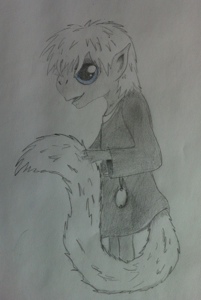
I drew a sketch of one of the characters from Imminent Danger, Miguri. He’s described as humanoid, 3 feet tall, brown-skinned, with massive blue eyes and a mop of white hair, plus a huge white, furry tail. He wears a brown, knee-length, belted tunic. Also, Eris thinks he looks like a cross between a monkey and a garden gnome, which kind of tickled me. And this is what came to mind:

20130322-133548.jpg

I didn’t say it was a GOOD sketch 😉

It’s a great description, isn’t it? But I’d be willing to bet money that Michelle Proulx’s mental image of Miguri is nothing like mine. There were still blanks to be filled in, weren’t there? Ear shape, for one. My mind made them big and pointy, I don’t know why. Face shape is another; I guess what I see in my mind came from the monkey thing. Even the shape of the milky-white gem on his belt and the way that it’s hanging are probably off; I picture a smooth, round gem, but in the author’s mind it could be cut and polished.

I like that. It’s like a collaboration between writer and reader, and something new is created every time a different person reads a story.

I also wonder what people think my characters look like, the ones I’ve created. I tend to lean toward less description; Rowan has auburn hair and grey eyes, fact. I know exactly what she looks like in my mind, but does it really matter if someone else pictures her differently? Not so much. Aren gets a bit more description as Rowan notices things about him, but again the details are up to the reader to fill in. Does it affect the story if I think Rowan has a few freckles? Not unless Aren notices them when it’s his turn to speak. Then it matters… but he generally has other things on his mind.

Likewise for creatures. I don’t have a plethora of aliens to describe, but I have critters and creatures. My horses are rather unusual, so they get a few extra lines of description, but when a dog appears and I say “brown shaggy mutt,” you guys can feel free to give him floppy ears or straight as you see fit. Heck, give him white socks and a black patch over one eye. Have fun with it.

Stephen King says a little about this in On Writing, and if you haven’t read that one, I highly recommend it. He’s an author who tends to give very little physical description of characters unless it’s important to the story (or his POV character is observing it), but I’ve never had trouble picturing his characters in my mind.

One other note, while we’re on the topic: do you guys remember when they revealed the casting for the Hunger Games movie, and there were people who were outraged that Rue was being played by a black girl? Oh, the horror. -_-  How dare they use this beloved character to promote some kind of… Well, I don’t even remember what the arguments were, I tuned them out, they all sounded like assholes. Basically, people thought it was political, and were for some reason upset about racial diversity.

Guess what?

“She has bright, dark eyes and satiny brown skin…”

The Hunger Games, chapter 7, page 98 in my edition. Quoted.

It doesn’t matter how you describe your characters, people are going to see what they want to see in their minds. If I pictured Miguri as a fluffy, pink-haired, horse-faced, 7-foot-tall thing with nifty shoes… that would be really weird, but I doubt the author would lose any sleep over it.

What do you guys think? When you’re reading, do you see characters clearly in your mind? Do you prefer more description, or less? When (and if) you’re writing, how badly do you want your readers to understand your vision of your characters, human or otherwise?


Kobo! Eek!

Forgive my excitement, I’m new to the e-reader thing.

Yes, I finally have an e-reader. No, my books aren’t jealous; we had a little talk about how much I love them, and how no machine will ever take their place in my heart. An e-reader will never feel the same, or smell the same, or give the same experience, but I am excited about it for several reasons.

Most of those reasons are books. Specifically, cheaper books. Also, the ability to carry them around without breaking my shoulder with my bag.

My mom passed her kobo on to me when she got a new kobo mini for her birthday (isn’t that awesome? Thanks, mom!). This newfangled contraption still seems a bit strange; it’s so light, it feels like it’s going to snap in half. It’s like one of those fake TVs they have at Ikea, but it’s real. It works. I know, I have an account and TWO WHOLE BOOKS HOLY CRAP TWO BOOKS.

And I’ve been waiting for a while to get these books.

Blogging’s fun, isn’t it? (I am going somewhere with this…) You get to meet other writers, and some of them have books you can buy! And read! Yay! So my first two purchases were books by bloggers I follow here on WordPress. In no particular order (with links!):

IMMINENT DANGER And How to Fly Straight into it   by Michelle Proulx

Born In Flames by Candace Knoebel

Whee! For less than $15, I have two new books to read that. No wait time, no shipping fees, cheaper than paperbacks. No, e-books are not real books, at least not as I think of them. But they’re real stories, and that’s what I’m paying for.

They’d better be good, guys… 😉

If you’re wondering, yes, I’ve already discovered books I can’t get through kobo; looks like I’m going to have to get Robertson Davies’  the Deptford Trilogy as a real book off of Indigo. I would have wanted them as a “real” book anyway, but it would have been fun to have them available this way. On the other hand, look how adorable it is when it’s sleeping! Aww… I can’t stay mad at that little face.

20130321-151206.jpg

Zzzzzz…

EDIT: I did it, I read a whole book on the kobo! Imminent Danger was way too much fun for you. You couldn’t handle it. I don’t usually read sci-fi, but I really liked this one. Recommended. Yay!

EDIT 2: OMG the free books that there are!


Other People’s Books: Born In Flames by C. Knoebel

I haven’t read this one yet, but it looks interesting. And hey, 99 cents, amirite? I’d be upset that I bought it for full price yesterday, except that a) I wouldn’t have bought it if I didn’t think it would be worth what I paid for it, and b) the sale is only on Amazon. So it’s all good. 😉


What’s In a Name? Everything.

…or sometimes nothing.

A few blogs I follow have posted on naming characters recently, and I keep wanting to comment, but I don’t think I should write an essay under some poor, unsuspecting person’s post. I’ve been meaning to break this topic out for a while (really- it’s on my list between “Look, MOAR NEW NOTEBOOK!” and “My cats, let me show you them”). Now seems like as good a time as any to share my experiences and a few thoughts on where to find the perfect name.

I’ll tell you right now: I suck at naming things. I don’t care whether it’s a character, a kid, a cat or a fictional country, I’m terrible at it. If I didn’t have my husband around to help, my kids would be named “Pending” and “Give me another minute to think.” I’m indecisive, and the more important the name is to me, the harder it gets; therefore it was easy to name my goldfish I had in college (Fluffy and Spike, may they float in peace), but it’s really hard for me to name fictional characters….Or to leave their names alone once I’ve picked them.

If I’d written this post two weeks ago, I would have told you that there’s only one significant character in Bound who hasn’t had a name change. I can’t say that anymore; now it’s all of them. Seems none of my beta readers were familiar with a YA series in which two protagonists are named Cassia and Kai… which are the names of a brother and sister in my books.

Huh.

Well, Kai’s keeping his name, so I guess Cassia’s getting a slight identity alteration. Bugger.

It’s not like it’s the first time it’s happened; like I said, they’ve all changed. I’d have loved to name my female main character after my favourite girl in my favourite book, but you can’t let someone in a story with magic go around with the name Abra (bonus points if you now know what my favourite book is). Abra… Cadabra. Not so much. I tried so many names on her, and absolutely nothing worked. It was enough to make me cry. I don’t want to give away the reason I finally settled on Rowan, but she is named after a tree (shrub?), and it suits her character. Good enough.

Aren was worse- he doesn’t make anything easy. Never has. Some of my friends were kind enough to let me bounce name ideas off of them, but nothing ever seemed to fit (and these sessions generally devolved into a laugh-fest of ridiculous suggestions, anyway). He had different names in two drafts of the book that were completely wrong; finally I just took out the list of potentials, started picking sounds I liked and smooshed them together in different combinations until something sounded right.

It’s a highly technical process, I won’t go into details.

Strange thing was, when I plugged my mish-mash into a baby names website, it came up as a Scandinavian name that nearly made me spit my drink all over the computer when I read the meaning listed for it. It was perfect, so much so that no one would ever believe that I got the name before the meaning.

That wasn’t the first strange coincidence to smack me in the face while I was writing this one, or the last. It was a really good one, though.

Other names came easier. Once Rowan had her name, her brother Ashe and sister Willow fell into theirs quite naturally; their parents are like that, I guess, with the coordinating names. I’m not judging. My dragon got her sort-of-name from her colour, certain water-dwelling folk drifted naturally toward aqua-centric names. Others were more difficult; bad guys need bad guy names, countries need… country names.

At least animals were easy.

So where did I find all of these fantastic names for my characters?

Everywhere.

Baby names websites are a good resource. Some, like babynames.com, will let you search by meaning, by origin, by gender, by first letter, or any combination of those. Handy, no? Great if you name characters by meaning. I usually don’t, becauseI think it can spoil surprises for readers, but it can work. Also, you learn some interesting things, like the fact that the name “Benjamin” means “Son of my right hand.” Very nice name, but seems like a piss-poor way to conceive a child.

*ahem* Moving on…

Geography: My big bad, Severn, shares his name with a river in the UK. Also a town in Ontario, but I prefer the river. It has an appropriately bloody history, apparently beginning with the drowning of a nymph, and the name is kind of scary. I didn’t learn about the body count until after I’d picked the name, but again, works for me.

Botany: Already covered this, see Rowan’s family (above).

Meaning: Obviously the aforementioned water-dwellers. Also, Rowan’s cousin Felicia. She’s a happy lass… for now. Wait for book 2.

Associations: No offense to anyone with names I’m going to mention here, OK? No hard feelings? Good. But some names just bring certain associations to mind, at least for me. Callum Langley comes from a good family. His father Dorset was just knighted. Can you imagine the same of Englebert Dingleberry and his father, Sheldon? No, neither can I. Sometimes I just picked names that sounded right.

Minor jokes: This one probably won’t survive final edits, but it amuses me greatly for now (small things, etcetera). There’s a guy whose sole purpose in the story is to die. He deserves it, but he doesn’t get a lot of dialogue before it happens. His name’s Mort. I like it, but I suspect it’s too punny for most readers. But hey, if something like that works for your story, I say run with it!

Zoology: I haven’t done it yet, but if a character had animal-like qualities, I’d check out the Latin names for a species to see if there’s anything there.

Mythology: J.K. Rowling uses this brilliantly in the Harry Potter books- now THERE’S someone who can work with names! Remus Lupin… should be obvious exactly what he is based on name alone, but it works. They all do. Best names ever.

Literature: Obviously this didn’t work out so well for me, but why not think over your favourite books and characters? Just be mindful of the associations thing I mentioned above. Naming a character Scarlett will give readers a very different feeling from naming her Martha.

Diseases: No, not really. But come on, admit it: Chlamydia sounds like the name of a Nymph or something, doesn’t it? Damn right it does. This is why it pays to at least check on the meaning of the brilliant name you’ve come up with.

Just keep your eyes open. Write down names you like, even when you’re not working on that aspect of a project. They’ll come in handy some day.

Oh, and one caution that a friend reminded me of during this process: If your reader doesn’t know how to pronounce the name, it’s going to be a distraction. Saorise and Siobhan are gorgeous names; many people will at best completely butcher them in their minds and at worst give up completely.*

Kwar’snix!blarg7f9att is not a gorgeous name, and no one should ever use it. Same principle applies.

Wow, this post is a lot longer than I meant it to be. Clearly I have a lot of issues to work out with this one. I’m traumatized, guys. My final recommendation if you find yourself in my position (ie being a complete moron about names): just pick a frigging name and plug it in there. “Find and replace” works, you can change it later. Yes, names will probably impact how you perceive your characters, but a placeholder name will get you a lot farther in your story than nothing.

So, where do you find names for your cats, characters, children, goldfish, etc?

*I’m not saying to never use these names, or others that aren’t pronounced the way they’re spelled, or that are confusing. But if you can slip in someone learning how to pronounce the name, it’s really helpful (see J.K. Rowling again, using a student from another school to clarify the pronunciation of Hermione’s name in The Goblet of Fire, and Jacqueline Carey using the same trick in Kushiel’s Dart). Very helpful for those of us who hear words in our heads when we’re reading and get frustrated when that trips us up.

A Fine Set o’ Reviews, They Be!

It’s Friday, I’m lazy, so I’m just going to leave this here. Taken together, these three book reviews are the single most satisfying and entertaining trilogy I have ever read. I laughed until I cried (literally, tears on my face).

Would I like to receive a review like this some day? Hell no, but I’d take this over most of the incoherent, non-GIF-filled muttering that most dissatisfied readers manage.

Katrina Passick Lumsden’s review of Fifty Shades of Grey

Fifty Shades Darker

Fifty Shades Freed

Also, I’m just going to leave this here, because it also made me laugh this week when some surreal news came out: This. So much.  <—- Seriously, click that.

EDIT: Wow- i before e posted these same reviews last night. Must be something in the air this week…


Critical

I don’t mind most aspects of the editing process, but there is one thing that really bothers me: when I’m editing my own work, I become extremely critical of other people’s.

In a way, it makes no sense. These are published books I’m finding fault with, so obviously they’re doing a lot of things right. Most things, even. Who am I to criticize? Me, way down here. Hi.

And I’m not- at least, not where anyone else can see. It’s not that I’m huffing and puffing and throwing books against the wall (usually), then taking to the internet to rail about how I could do so much better. Not at all. I have so much respect for the work that people put into their stories, that their editors do to make it the best it can be, yadda yadda.

All I’m saying is that when I’m editing my own work, it makes it very difficult for me to enjoy other people’s, because I’m subconsciously analyzing everything, evaluating it the way I’m evaluating my own work, spotting the things I would consider fixing if the story was mine, things that work and things that don’t. And it’s really, really annoying.

Right now I’m reading a book I got for Christmas, and of course I’m not going to mention the name of it here. It’s an interesting book- fresh take on the vampire thing, I think (I’m only a few chapters in), where they’re monsters and not love interests. Yay! I should be enjoying it, but it’s hard when my brain won’t just shut up about “uh-huh, jumping right into the main conflict,” or “yep, slipping backstory in there, very smooth.” And that’s when things are going well. I got to page 53-ish and found out (because it’s actually stated outright) that one character is on a mission to save the world, and another is THE KEY TO SAVING ALL MANKIND OMG, and I wanted to put it down and read something else.*

Are those bad things in and of themselves? I guess not. It certainly sets the stakes high, doesn’t it? Now it should matter to me whether this guy succeeds at winning over the special girl who doesn’t know she’s special. But I was disappointed, and that’s probably not fair. Is the “savior of the world” thing overdone? Yes, but that’s no reason to think that a new take on it can’t be exciting. But all I can think is “well THAT was clumsy… Try to save the world, please, but don’t tell me you’re doing it!” If it was a library book, I’d probably have quit. Again, unfair, but I’ve done it before.

And the little things, like a character frequently saying things like “I felt the wind blow my hair” rather than just telling me that the wind blew her hair (obviously you feel it…). Things that I can see people picking on if I wrote it, and that I therefore try to be careful not to overuse. But when I’m reading, I’d like to be able to not notice that, to just see the wind blowing her hair (and/or her feeling it).

At least this one’s not overdoing the adverbs. I recently put another (very popular) book down because the writing style bothered me, and that was a big part of it. Effective when used sparingly, irritating when every time he grinned it was wolfishly, and every time she hurried is was quickly.

I read so much about what works and what doesn’t in writing and why that I pick it out in everything I read. My life has become a high school English class, and it’s driving me insane.

I wish I could let it go when I step away from the computer. I know my work is as bad as or worse than anything these people do, and that I’m probably doing a lot of the things I’m so critical of. My writing certainly has flaws that I’m blind to. I don’t mean to be critical. I just want my brain to shut up and enjoy the effing story already.

Does anyone else have this problem, or are you able to compartmentalize, to leave work at the office, so to speak?

*I’m still hoping that it turns out he’s wrong, that she can’t save the world through her powers and they’ll have to struggle together to find another way. How fun would that be?!


Anastasia Writes

politics, engineering, parenting, relevant things over coffee.

Beth Camp

Writer of historical fiction and teller of tales . . .

rogerbloomsfield

An Aspiring Author's Adventure

TBN Media

Life, writing, books, dragons- not necessarily in that order. Home of USA Today bestselling Fantasy author Kate Sparkes.

Allie Potts

Author, Writer, & Inventor of Worlds

The Wordy Rose

"Either write something worth reading, or do something worth writing." - Benjamin Franklin

Shan Jeniah's Lovely Chaos

Finding Yessings and Blessings in Lifes Messings!

Little Rittwolf's Book Blog

I thought having my own blog would help me....Squirrel!....stay more focused. I could be wrong.

The Sword of Air

Stunning new multitouch iBook by breakthrough author R.J Madigan

CHOUETT

Read it! 📖 Spark it! ✨

Denise D. Young

Wild Magic. Wild Stories. Wild Souls.

chestnut book blog

Read. Recommend. Revel.

inkedrainbowreads.wordpress.com/

LGBT Book Reviews, Cover Reveals & More! We are a group designed to help promote and review LGBT et al books. We were created out of seeing a need and wanted to have that need filled. We pride ourseles of having opinionated reviews that are unique and helpful to the author. Welcome to a world of the best LGBT et al books out there!

Dionne Lister | USA Today Bestselling Author

I love sharing my stories, but I wish they wouldn't keep me awake at night.

Avid Reviews

Fantasy and Sci-Fi Reviews For Both Self-Published and Traditionally Published Books

Author Jen Wylie's Blog

Welcome to my mind... Blog for fantasty author Jen Wylie

Pete Morin

Fiction about lawyers, cops and politicians.